



Legal review: reviewed by Nathalie Dreyfus on 14 August 2026. This general information is not legal advice for a specific matter.
Chinese companies and their IP firms can obtain national trademark protection in France by filing an application with the French National Institute of Industrial Property, or INPI. A successful filing requires the correct applicant details, an exact representation of the mark and a precise list of goods and services. Availability, priority and the risk of opposition should be assessed before filing.
This guide explains the principal stages of a French national trademark application. It is intended as general information for Chinese applicants and counsel. The appropriate strategy depends on the mark, the client’s markets and existing rights.
Is a French national trademark the right route?
A French national trademark application protects the mark in France. It may be appropriate where the client’s immediate commercial activity, distribution network or enforcement need is concentrated in the French market.
Other possible routes include:
- a European Union trademark covering the EU Member States;
- an international registration designating France;
- an international registration designating the European Union;
- separate national applications in selected European countries.
The decision should take account of the client’s launch markets, budget, earlier rights and tolerance for unitary EU-wide risk. A French national filing and an EU filing are not interchangeable.
Who can apply?
An individual or legal entity can apply for a French trademark. For a Chinese company, the applicant’s legal identity should be consistent across the Chinese registration documents, the English transliteration and any earlier international filing.
Prepare:
- the company’s complete legal name;
- its registered address and legal form;
- the country of incorporation;
- the Chinese-character name and consistent Latin-character version;
- evidence of any assignment, merger or change of name affecting ownership;
- the details of the appointed representative and correspondence contact.
The applicant should be the entity that is intended to own and control the French right. Filing in the name of a distributor or an unrelated affiliate without a clear ownership strategy can create avoidable problems.
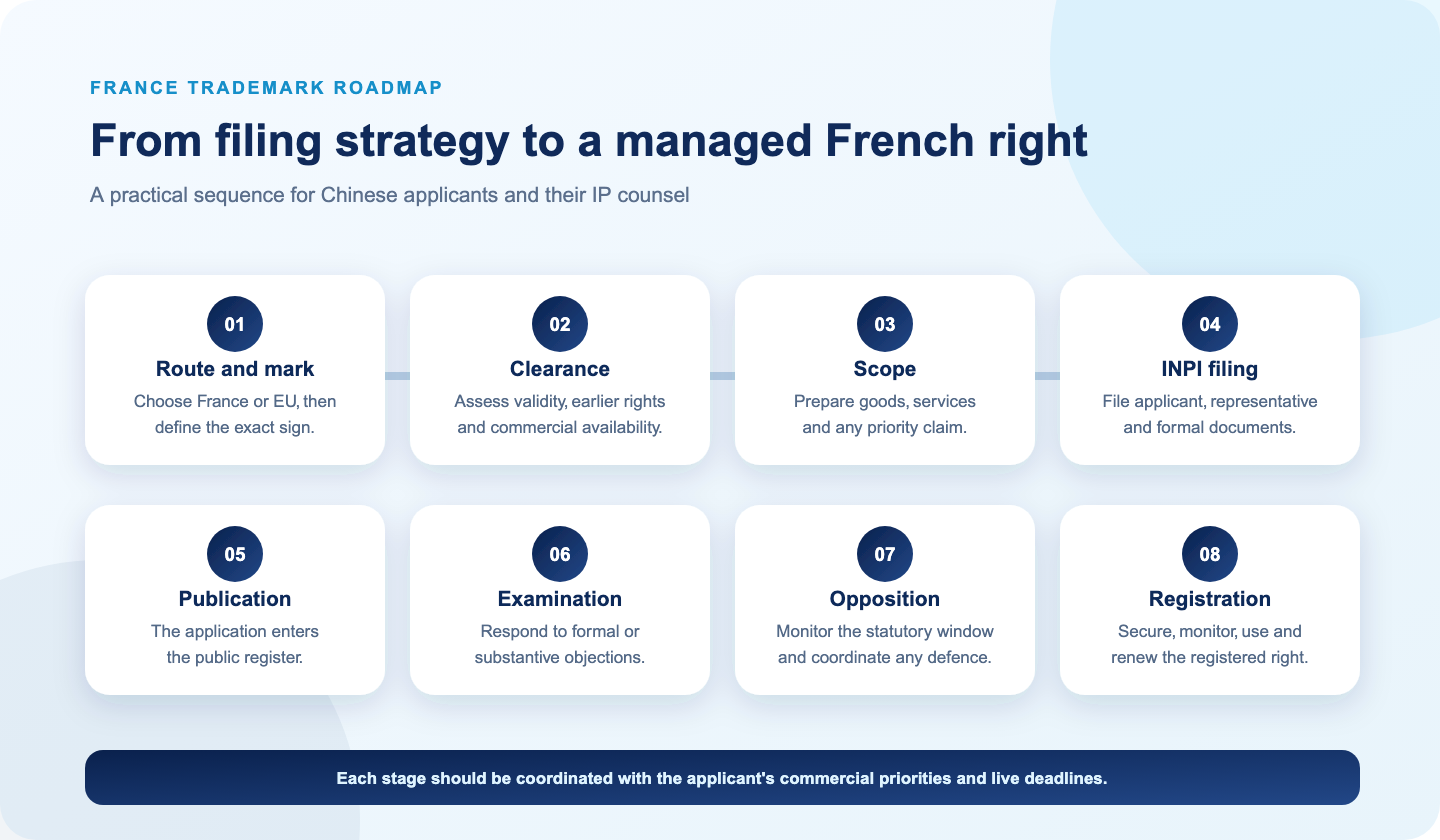
Step 1: define the mark to be filed
The application must contain one clear representation of the mark. Common options include a word mark, a figurative mark or a combined word-and-logo mark.
Chinese applicants should consider whether protection is needed for:
- the Chinese-character brand;
- its pinyin or other transliteration;
- the Latin-character export brand;
- a logo or combined device;
- a French-language version used in the local market.
A combined application protects the sign as filed. Where different elements are used independently, separate applications may provide a more flexible portfolio. The appropriate choice should be reviewed against the planned use and enforcement strategy.
Step 2: assess validity and availability
Before filing, the applicant should consider whether the sign can function as a trademark and whether earlier rights may create a conflict.
An initial assessment normally considers:
- distinctiveness;
- descriptive or generic meaning in French;
- potentially misleading elements;
- public-policy issues;
- earlier French, EU and international trademarks effective in France;
- relevant company names, trade names and domain names;
- visual, phonetic and conceptual similarities.
The INPI recommends checking both the validity and availability of the proposed mark before filing. A search result is not a registration guarantee, but it helps identify objections, opposition risks and possible changes to the filing strategy.
For Chinese-language marks, the assessment may also need to consider pronunciation, transliteration and how the relevant French public will perceive the sign.
Step 3: prepare the goods and services
A French trademark does not protect a name for every possible commercial activity. Protection is limited to the goods and services listed in the application.
The list must therefore be aligned with:
- the products and services already sold;
- the planned French market entry;
- distribution, retail and online services;
- software, digital or platform functions;
- licensing plans;
- reasonable short-term expansion.
Goods and services are organised according to the Nice Classification. The filing cost depends in part on the number of classes selected.
The wording must be prepared carefully because the scope cannot be expanded by adding new goods or services after the application has been paid and filed. A list copied from an earlier Chinese application may not accurately reflect the French project or the wording accepted by the INPI.
Step 4: decide whether to claim priority
Where the same applicant has filed the same mark first in a country that qualifies under the Paris Convention or World Trade Organization framework, priority may generally be claimed in France within six months of that first filing.
Provide local counsel with:
- the country of first filing;
- the filing date and application number;
- the applicant’s exact name;
- the representation of the mark;
- the goods and services covered;
- the official filing receipt or certified document where required;
- any required translation.
The data should be checked before submission. Differences in the owner, sign or scope may affect the validity or extent of the claim.
Step 5: file the application with the INPI
French trademark applications are filed online through the INPI procedures portal. The application identifies the applicant and any representative, the type and representation of the mark, the goods and services, and any priority claim.
Before final payment, the filing data should be reviewed as a complete record. Some mistakes can be corrected later, but the essential scope of the application cannot simply be rewritten after filing.
Once submitted, the applicant receives a national filing number and receipt. This information should be checked immediately and stored with the client’s portfolio records.
Step 6: publication and examination
According to the INPI, the application is normally published in the Official Industrial Property Bulletin, or BOPI, within approximately six weeks. The INPI then examines whether the application is complete and meets the applicable legal requirements.
An objection or irregularity may require:
- correction of formal data;
- clarification or limitation of goods and services;
- legal submissions on the validity of the sign;
- supporting evidence;
- partial or total withdrawal where appropriate.
Every official notification should be reviewed promptly. The applicable response deadline is stated in the communication and must be independently recorded.
Step 7: the opposition period
Following publication, holders of qualifying earlier rights generally have two months to file an opposition against the French application.
An opposition may allege that the new application conflicts with an earlier trademark or another recognised earlier right. The procedure is written and adversarial. The parties may exchange arguments and evidence, and the INPI issues a decision after the instruction phase.
Before filing, an availability assessment can help identify the most significant opposition risks. After publication, the applicant and its counsel should monitor communications and be ready to evaluate negotiation, limitation or defence options.
Step 8: registration and certificate
If the application satisfies the examination requirements and is not successfully opposed, the INPI registers the mark and publishes the registration in the BOPI. The INPI indicates that registration can occur after a minimum period of approximately five months where the procedure proceeds without blocking issues.
The registration certificate should be checked for:
- the owner’s details;
- the representation of the mark;
- the goods and services;
- the filing and registration dates;
- any limitation or priority claim.
Any error should be raised without delay.
After registration
A French trademark registration is valid for ten years and can be renewed for further ten-year periods. Registration is only the beginning of portfolio management.
The owner should organise:
- watching for later conflicting applications;
- evidence of genuine use;
- recordal of assignments, licences, mergers and name changes;
- domain name and online marketplace monitoring;
- customs and enforcement measures where appropriate;
- renewal instructions well before expiry.
The INPI notes that a mark may become vulnerable if it is not put to genuine use for an uninterrupted period of five years. Evidence should therefore be retained in a form that links the mark, relevant goods or services, territory and period of use.
Common mistakes for cross-border applicants
Inconsistent applicant names
Different English transliterations or outdated corporate details can create ownership and priority issues.
Filing only the export logo
The Chinese-character, transliterated and Latin-character signs may require separate consideration depending on actual use.
Copying an excessively broad specification
The French list should match the commercial project and use clear, accepted terms.
Ignoring French-language meaning
A sign that appears distinctive in China may be descriptive, misleading or otherwise problematic for the French public.
Missing the priority deadline
The local counsel needs the first-filing information and supporting documents before the six-month period expires.
Treating filing as the end of the project
Opposition monitoring, official notifications, evidence of use and renewal must be managed throughout the life of the right.
French trademark filing checklist
Before instructing local counsel, confirm:
- applicant’s full legal identity;
- final sign or signs to be filed;
- French market and commercial objective;
- precise goods and services;
- earlier filing and priority details;
- search reports and known conflicts;
- desired filing date;
- reporting contacts and approval process;
- billing information;
- instructions for monitoring after filing.
Practical example: preparing a French launch before filing
Illustrative scenario: this example reflects recurring cross-border issues and is not a description of a specific client matter.
A Chinese exporter plans a French launch using a Chinese-character name, a Latin-character brand and a logo. Its draft specification reproduces a broad Chinese filing. French counsel identifies which signs and products will actually be used in France, reviews the French wording, checks priority and earlier-right risks, then compares a French national filing with an EU route. The client can choose a strategy aligned with its launch territories and budget. Any registrability assessment remains subject to the specific search results and examination.
Where specialist French counsel adds value
A French trademark filing is only the visible part of the assignment. The real value lies in connecting the filing to the client’s European launch, earlier rights and future enforcement needs.
Where the project extends beyond trademarks, Dreyfus can coordinate related design, domain name, copyright, digital-asset and unfair-competition issues in France and the European Union. This integrated view helps Chinese counsel and companies avoid fragmented instructions and inconsistent portfolios.
Frequently asked questions
How long does French trademark registration take?
The INPI states that registration may be published after a minimum period of approximately five months. Objections, irregularities, observations or opposition proceedings can extend the timetable. A specific completion date should not be guaranteed.
Does a French trademark protect the whole European Union?
No. A French national trademark protects France. EU-wide protection requires an EU trademark or another appropriate route.
Can more goods and services be added after filing?
The scope cannot be expanded after the application has been paid and filed. A new application may be required for additional goods or services.
Is a search mandatory?
An availability search is not the same as a formal filing requirement, but the INPI strongly recommends checking validity and availability. A professional assessment can help identify similar earlier rights and filing risks.
Should a Chinese company appoint French counsel?
Local counsel can prepare the specification, assess French-language and earlier-right risks, manage official communications and coordinate opposition or enforcement. The appropriate representation arrangement should be confirmed for the particular procedure.
How Dreyfus supports Chinese applicants
Dreyfus & Associés advises Chinese IP firms, agencies and companies on French trademark clearance, filing, prosecution, opposition, cancellation, monitoring and enforcement. We can work on a white-label basis with Chinese counsel or participate visibly as French and EU representatives.
Contact our team for an initial conflict check and a clear scope, budget and procedural timetable. Do not send confidential documents before the conflict check.
Official sources
- INPI, filing a French trademark
- INPI, key stages of a French trademark application
- INPI, applicant and filing cost
- INPI, after registration
- INPI, trademark opposition